

Accurate application of POS 11 in medical billing is crucial for ensuring timely reimbursements, maintaining payer compliance, and optimizing claim submissions. When to use POS 11, when not to use it, and how it impacts the provider’s payment might be confusing to even experienced billers. After years of examining payer audits and claim errors, one recurring problem emerges: utilizing the incorrect service code has a direct impact on income. In order to prevent denials , bill accurately and maintain compliance with CMS and commercial insurance regulations, this guide simplifies everything in a clear and useful manner
What Is POS 11 in Medical Billing?
- POS 11 (place of service 11) denotes “office,” indicating face to face patient services rendered within a physician’s office, excluding hospital , urgent care or telehealth settings.The CMS defines an office as a non-facility permanently staffed location where healthcare professionals routinely provide patients care.This definition is consistent with the majority of practices nationwide. This includes:Family practice clinics Dermatology clinics Behavioral offices Physical therapy or rehab offices Chiropractic clinics Specialist offices (endocrinology, gastroenterology,cardiology etc) POS 11 is the appropriate place of service if the patient is physically present and the procedure is carried out in the provider’s private office
When Should You Use POS 11?
POS 11 should be assigned by a biller when:
1. The patient visits the physician’s private office
The majority of routine in-person appointments, including E/M visits (99202–99215), take place in the office.
2. Minor procedures are done in the office
- Examples consist of: Cryotherapy Joint infections Trigger point injections Ear lavage Wound care Skin biopsies
3. Diagnostic testing is performed inside the clinic
A lot of clinics conduct rapid tests in-house. POS 11 is applicable to:
- Strep testing
- Urinalysis
- EKGs
- Spirometry
- Glucose testing
4. Behavioral health or therapy sessions performed in-offic
When performed in person in the clinician’s office, CPTs like 90791, 90834, 90837, and others are invoiced using POS 11.
Examples of When POS 11 Is Correct
Example 1 – Family Medicine
A patient with a fever and cough goes to family practice. With POS 11, the provider bills 99213
Example 2 – Dermatology procedure
In the clinic, a dermatologist performs mole removal. Correct bill 11102 with POS 11
Example 3 – Physical Therapy Office
The patient receives regular therapy from a therapist. Bill 97110, 97140, 97014 with POS 11
Example 4 – Psychiatric clinic
An in-person treatment session inside the office 90837 with POS 11 POS 11 is required for any service rendered inside the provider’s private office.
Why POS 11 Pays Higher (Non-Facility Rate)
A key imperative for billers to comprehend POS 11 stems from the fact that Medicare and commercial insurers provide augmented reimbursement for office-based visits. Why? Because private office providers manage their own overhead, including personnel, utilities, rent, supplies, and equipment. Accordingly, CMS allocates a “non-facility RVU,” thereby facilitating a higher reimbursement rate compared to the services rendered in hospital outpatient settings.
Example (Illustration only)
- 99213 in POS 11: $92 99213 in POS 22: $74
This payment plan adheres to established CMS valuation techniques that are frequently used in all national reimbursement systems. The reason for this discrepancy is that POS 22 pays less and is regarded as a facility setting. This distinction shows the facility vs. non-facility payment structure, something payers consistently follow.
POS 11 vs. Other POS Codes
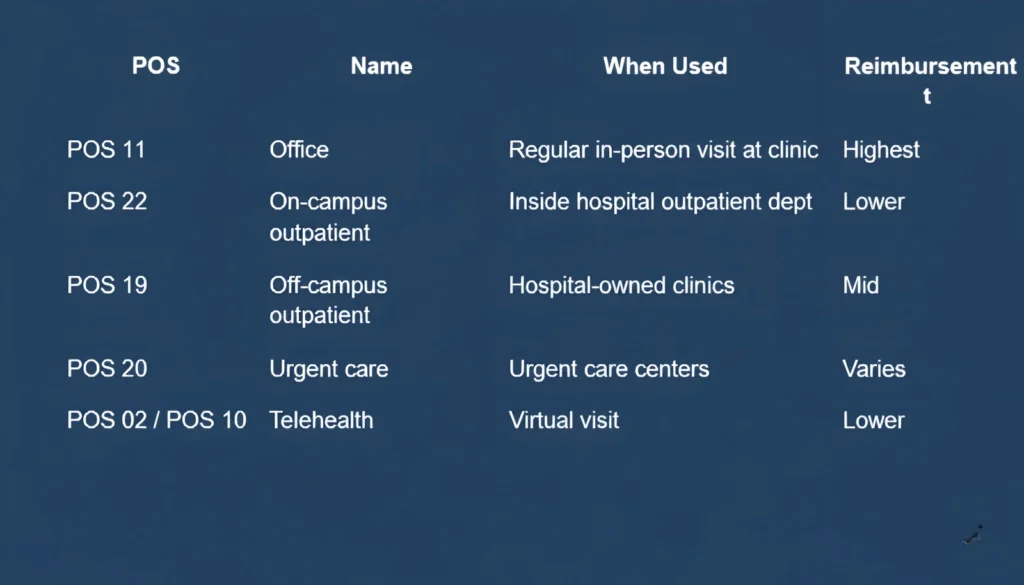
Common Claim Denials Related to POS 11
Every year thousands of claims are denied due to incorrect POS codes. Comprehensive payer audits and regular CMS, Medicare, and insurer rules serve as the foundation for these refusal trends. These are the most typical errors
1. Provider works in hospital owned clinic
POS 11 is typically prohibited in clinics that are owned by hospitals. Depending on the location, either POS 19 or POS 22 must be used.
2. Using POS 11 for virtual visits
POS 02 or POS 10 are necessary for telehealth; POS 11 is never required
3. Incorrect CPT + POS combinations
Due to equipment requirements, payer regulations or risk, certain treatments cannot be invoiced in office settings
4. Incorrect provider location in NPI registry
You risk rejection or an audit if you bill POS 11 and the NPI database indicates a different location.
5. Payer-specific policies ignored
POS behavior varies among Medicaid, UHC, Medicare, Cigna, Aetna, and BCBS.
How to Avoid Denials When Using POS 11
To prevent false claims and problems with reimbursements:
1. Verify the practice ownership
Services rendered in hospital-owned facilities are excluded from POS 11 designation
2. Verify payer rules
Certain CPTs that are billed using POS 11 are rejected by some insurance
3. Update the EHR/PM system
Ensure that the right POS code is mapped with every site
4. Verify face-to-face documentation
Proof of physical presence may be required by insurance
5. Check non-facility RVUs
Medicare mandates that POS 11 be billed at the non-facility rate
6. Don’t mix POS codes for the same DOS
Automatic denials occur when POS 11 and POS 22 are billed for the same day
CPT Codes Commonly Used with POS 11
The codes that are most commonly built with POS 11 are as follows:
- E/M codes 99202 – 99205 (new patients) 99212 – 99215 (established patients)
- Procedure codes 11102 (biopsy), 17000 (destruction lesion), 20550 (injection), 93000 (EKG), 81002 (urinalysis), and 82947 (glucose test)
- Behavioral health 90791 90832 90834 90837 Office visits are frequently paired with these codes
Insurance Guidelines for POS 11
These guidelines are based on actual audit findings and established payer policies that are adhered to by major healthcare networks.
- Medicare For POS 11, Medicare pays the highest non-facility rate. Documentation needs to be backed up: In-office interaction The service’s location Signature of the provider
Medicaid states have different POS regulations. The treatments that can be carried out in offices are restricted in certain states. BCBS Strict about the distinctions between hospital-owned clinics. POS 11 may be refused to departments with off-campus providers Aetna Permits minor POS 11 procedures and the majority of E/M. Clean documentation is necessary Cigna Claim bundling is frequently caused by POS problems. Verify that CPT corresponds to an office-performable service
Real-World Case Study
99214 is billed by a primary care physician using POS 11 Scenario A– Correct Billing Private office In person visit CPT 99214 with POS 11 Claim pays $135 (example) Scenario B—Incorrect Billing Scenario B–Incorrect Billing The provider bills POS 22 in error Only $95 is paid by insurance Outcome: In a single claim, the incorrect POS code resulted in a $40 loss. Thousands of dollars are lost when you multiply with hundreds of visits
Frequent Mistakes When Using POS 11
These are the most common errors made by medical billers:
- Telehealth with POS 11: POS 11 billing for medical professionals working in hospital-based clinics Not updating the EHR’s locations Inaccurate NPI address, absence of face-to-face documentation In office settings, billing practices are prohibited Incorrect taxonomy codes Mistakenly using POS 11 for home visits Not reviewing policies for commercial insurance Medicare’s non-facility RVU regulations are not being followed By avoiding these errors, you can maintain the integrity and compliance of your claims
Best Tools and Resources for Correct POS Coding
- Code set for CMS place of service
- The Medicare Physician Fee Schedule (MPFS)
- AMA CPT codebook
- EHR/Practice Management Software (Kareo, eClinicalWorks, Athena)
- Clearing houses (office Ally, availability)
- State Medicaid Regulations
By using these technologies, accuracy is maintained for all insurance providers
Frequently Asked Questions
1. What is a POS code 11?
POS code 11 means “office.” It’s used in medical billing when a service is provided in a physician’s office
2. What is reason code 11 in medical billing?
Reason code 11 usually means the claim lacks required information or the service is not covered under the patient’s plan. The payer needs clarification or correction before payment.
3. What does POS stand for in medical billing?
In medical billing, POS stands for “Place of Service.” It identifies where the patient received the healthcare service.
4. What is occurrence code 11?
Occurrence code 11 indicates the date of onset of symptoms or illness on a medical claim.
Conclusion
POS 11 constitutes a frequently utilized yet often misapplied place of service code in medical billing. Accurate application facilitates claim processing, optimal reimbursements, and regulatory adherence with CMS and commercial insurers. Rigorous verification of practice settings, payer stipulations and CPT code alignment with place of service designation is essential to preclude denials and revenue loss


